
Springdale Previous Resident Sources
No single roll spans the life of a Springdale address. The current assessor anchors today's parcel. Recorder indexes move ownership backward. Directories and census records add occupants, while maps, permits, photographs, probate files, and obituaries provide time and context.
| Source | Years covered | Where held | What it shows |
|---|---|---|---|
| Washington land records | Historical search 1834-1991 plus current route | Washington Circuit Clerk | Deeds, mortgages, liens, plats |
| Benton deed index and images | Index from 05/03/1945; images from 01/31/1933 | Benton Recorder web service and counter | Names, instruments, full deeds |
| Current assessment roll | Current; historic depth not stated | Applicable county assessor | Owner, parcel, situs, mailing, improvements |
| Springdale directories | Verified holdings from 1908 through regional volumes ending in 2016 | Shiloh Museum research library | Households, businesses, addresses |
| Sanborn maps | 1897, 1904, 1909, 1914, 1924, 1948 | Library of Congress | Footprint, use, material, street context |
| Building permits | Start year unpublished | Springdale Building Department | Alteration and demolition records |
Choose the source by year. A present parcel search cannot name all past residents, while a 1924 fire-insurance map usually cannot name an occupant. Combined evidence is stronger than either source alone.
Start With Today's Springdale Parcel
First determine whether the address lies in Washington or Benton County. Springdale GIS keeps county, postal community, incorporated municipality, and E911 jurisdiction as separate fields. After choosing the county, record the assessor's exact owner name, parcel number, situs address, mailing address, legal description, subdivision, lot, block, and current deed reference.
In Benton County, Property Information accepts a name, address, or parcel ID and returns ownership, acreage, current deed, survey plats, elected districts, and school district. Washington County offers a free linked property search and public webmap through its Assessor. Call the office when spelling or parcel resolution fails.
The legal description is the vital carryover key. Unlike a house number, it can survive a changed street label, a postal mismatch, or a later annexation. The assessor's mailing address may show where tax correspondence goes, but it does not prove who lived at the situs.
Springdale Deed Chain Backward
The deed chain traces prior owners, not every household. Begin with the present acquisition deed and work seller by seller. Confirm each hit through the legal description because common names can lead to unrelated Springdale land.
- Retrieve the current owner's acquisition deed and copy the grantor, grantee, date, instrument or book and page, legal description, and prior references.
- Search the seller as an earlier grantee. Restrict by date and confirm that the same land description appears.
- Repeat the handoff. In Benton, use book and page before October 30, 2017, and an L instrument number after that date.
- In Washington, bridge the current system into the separate 1834-1991 historical index.
- At an online cutoff, use clerk-counter books, original indexes, microfilm, mail, or a certified-copy request.
- Grantor and grantee
- The grantor transfers the land; the grantee receives it.
- Chain of title
- The linked series of transfers for the same land.
- Legal description
- The parcel's lot, block, subdivision, or survey wording rather than its mail address.
The Benton County Land Record Web Service is the county's index entry point.
Its published milestones make the fallback clear: the public deed index begins in 1945, images begin in 1933, and earlier books require office research.
Washington Records Before Modern Search
Central and historic Springdale usually leads to Washington County. The Circuit Clerk records deeds, mortgages, releases, plats, surveys, judgments, liens, leases, and other land instruments. County navigation separates current indexed records from the 1834-1991 historical land search. In-person and mail delivery remain available at the recorder in Fayetteville.
The Washington County historical record search is an unusually deep online bridge.
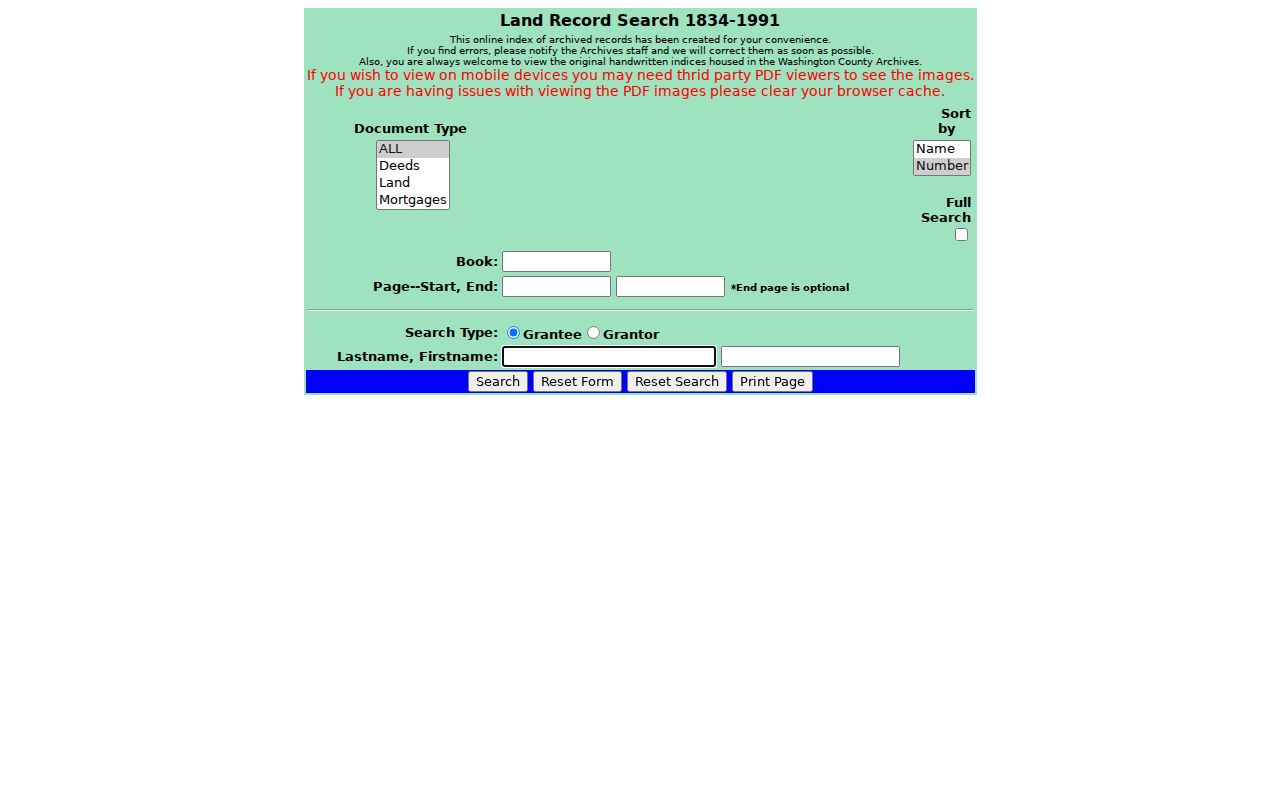
The Archives warns that the typed index is a convenience. When a surname fails, inspect the original handwritten grantor and grantee volumes and use a known book and page. A transcription is not the legal record.
Washington County also preserves marriage, court, school, tax, assessment, license, and 1919 voter records. These sources can add a named clue after the land chain reaches a past owner. They should be searched as separate record groups, not treated as proof that every owner resided at the parcel.
Springdale Past Residents Beyond Owners
Ownership and occupancy split often. A renter, relative, boarder, or employee may appear in a directory or census but never in the deed index. Shiloh Museum holds Springdale city and business directories, county history, obituaries, land-patent maps, family histories, periodicals, and 45 drawers of vertical files. Research is available on site or remotely by email, phone, or mail, with appointments given priority.
Verified holdings begin with a 1908 Springdale directory and telephone books from 1920. Later runs include Sterling volumes from 1952 and 1959, Moorhead from 1961-72, Johnson from 1974-88, Polk from 1994-2009, and regional or telephone titles through 2016. The Springdale directory-book collection provides the full shelf context.
- Choose a directory nearest the deed date and read the address or householder index.
- Search names and the address, including spelling variants and legacy street forms.
- Pair the result with a released federal census year under the 72-year rule.
- Compare household members, occupation, nearby addresses, and ownership clues.
- Return to the next directory year to date an arrival, departure, or change.
Note: A directory entry is a dated observation, not proof that the same household stayed until the next printed volume.
Map Earlier Springdale Households
Sanborn fire-insurance maps date the built setting around previous residents. Springdale grew from two mapped sheets in 1897 to nine sheets in 1948. The November 1924 edition has eight sheets and supplies a clear pre-digital checkpoint for building footprint, use, materials, and street context.
Compare the map's block and structure with the parcel's legal description and the directory observation. The sequence can show whether a building existed, changed use, expanded, or vanished. It usually does not name the household, so it must be paired with directories or census schedules. Later Springdale permits can document building, electrical, mechanical, plumbing, sign, moving, or demolition work, though no public historical address portal or permit start year was verified.
The 1924 Springdale Sanborn map is free to inspect. If an address cannot be found, try the city GIS legacy-street fields and the land description rather than assuming a citywide renumbering. No verified Springdale renumbering year was found.
Probate Ends a Springdale Trail
A former owner who disappears from the deed chain may have died before the next transfer. Public probate filings can connect the deceased person to an estate representative or heirs. Obituaries and cemetery information can add relatives, dates, and later locations, while a deed still proves the land transaction.
Washington County's probate record reaches back to an 1829-39 court book preserved by University of Arkansas Special Collections. Access requires advance contact. For later work, the Washington County Clerk supports probate functions, and the Circuit Clerk keeps related public court material. Benton searches follow the matching Benton offices. Search ARCourts can provide a modern party index, while a custodian supplies the public case file or certified copy.
The Washington chancery records catalog offers another route into historic equity and land disputes.
That catalog is a finding aid. Availability, restrictions, and the record image must be confirmed through the holder.
Human-use tip. A probate file can reconnect a deed trail to heirs when an obituary or later transfer no longer names the former owner clearly.
Search Shiloh and Springdale
Nineteenth-century research needs both place names. The settlement was known as Shiloh or Holcombe Springs before an 1872 post-office petition prompted Sarah Reed Meek to suggest Springdale. The town incorporated in 1878, and the railroad shifted the commercial center toward its tracks and later Emma Avenue after 1881.
Those are record-era labels, not separate modern towns. Search early newspapers, land files, church material, maps, and vertical files under Shiloh as well as Springdale. Shiloh Museum staff also advise searching a person's school, church, club, business, or town when no surname file exists. Full names, nicknames, and spelling variants matter in a city shaped by later Hispanic and Marshallese migration.
A museum case study shows the value of adjacent annual volumes: Davis and Reed appeared on Mill Street through 1969, moved to Commercial Street in 1970, and Davis continued into the 1990s. A directory sequence can date a move more closely than a deed when the business or occupant did not own the building.
Limits on Previous Resident Claims
Call a deed party a former owner unless another source proves residence. Call an assessor name the titled owner, not the current occupant. A homestead flag or matching mailing address can support owner occupancy, but neither lists the full household. Protected voter addresses, utility accounts, student files, delivery data, and motor-vehicle addresses stay outside a lawful house-history search.
Use all documented access channels. Search online first, then consult the assessor, recorder counter, original index, library, archive, or museum. Request certified copies when legal proof matters. A narrow Arkansas Freedom of Information Act request can seek existing city permit records, but it cannot require Springdale staff to create a new address history.
Lawful use. Research Springdale previous residents for house history, genealogy, heirs, or personal curiosity. Do not track, intimidate, or harass a living person.